

How Modified Atmosphere Packaging Actually Extends Fresh Meat Shelf Life
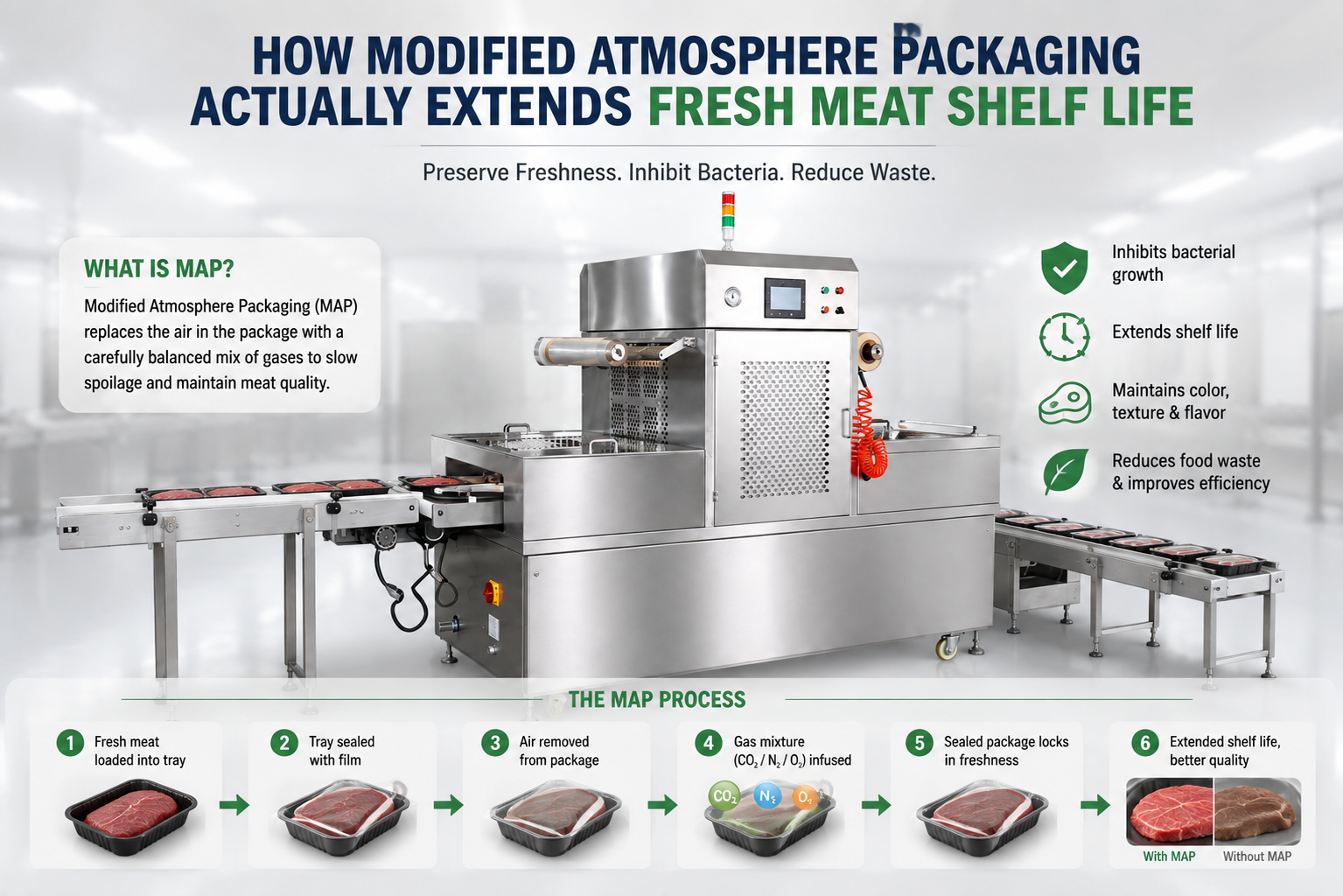
Modified atmosphere packaging gets sold and bought as a shelf-life feature, but the shelf-life extension it delivers is entirely a function of gas mix accuracy and pack integrity — not simply the presence of a gas flush step in the packaging line. A MAP machine that doesn't control gas ratio precisely, or doesn't achieve a reliable seal, delivers a fraction of the shelf-life benefit the technology is capable of.
What the Gas Mix Is Actually Doing
Fresh red meat packaging typically uses a high-oxygen mix — commonly in the 70-80% oxygen range combined with carbon dioxide — where the oxygen maintains the bright red oxymyoglobin color consumers associate with freshness, while the carbon dioxide inhibits aerobic bacterial and mold growth. Poultry and some processed meat formats more often use a different ratio, sometimes including nitrogen as an inert filler gas to maintain pack shape without contributing to spoilage or oxidation. Getting this ratio wrong in either direction — too little CO2 and spoilage-inhibiting benefit drops sharply; too much oxygen imbalance and off-color or accelerated oxidation results — undermines the shelf-life extension the whole process exists to deliver.
Why Pack Integrity Matters as Much as Gas Ratio
The correct gas mix delivers no benefit if the seal doesn't hold it. Seal integrity — consistent, void-free sealing across every pack, not just most of them — is what actually keeps the modified atmosphere in place for the full intended shelf life. A packaging line with inconsistent seal quality effectively produces a mix of properly-extended and prematurely-spoiling packs from the same production run, with no visible way to distinguish them before the failure shows up downstream.
What to Look for in MAP Equipment
● Gas ratio control accuracy — the mixing system should hold the specified gas ratio consistently pack to pack, not drift as the gas supply cylinders deplete over a shift
● Residual oxygen monitoring — for facilities serious about shelf-life claims, in-line residual oxygen measurement after sealing verifies the intended atmosphere was actually achieved in the finished pack, not just dispensed toward it
● Seal integrity validation — consistent seal quality across varying pack sizes and film types, since a MAP line often needs to run multiple SKUs with different tray dimensions
● Gas flush efficiency — how completely the machine purges ambient air from the pack before introducing the target gas mix, since residual ambient air dilutes the intended atmosphere
Matching MAP to Your Export Shelf-Life Target
Different export markets and retail formats have different practical shelf-life expectations, and the gas mix, film barrier properties, and seal specification should be chosen against that specific target rather than a generic default. A shelf-life claim printed on packaging that the actual gas ratio and seal integrity can't support is a food safety and commercial risk that traces directly back to how the MAP equipment was specified.
Talk to Meatech About Your Packaging Line
Meatech's modified atmosphere packaging machine supports precise gas ratio control and consistent seal integrity across varying tray and film formats. Contact our team to match a packaging specification to your target export shelf-life claims.

We warmly invite potential customers, agents and distributors to partner with us — to explore markets together and share in the opportunities that a growing global food processing industry continues to present.
SOLUTIONS
CONTACT US
Building 1, Tianyi Renhe Longyue Shangjing, No. 15 Xiangtan Road, Chengyang District, Qingdao, China
Copyright © 2026 Qingdao Meatech Machinery Technology Co.,Ltd. All Rights Reserved.


