

Meat Slicing vs Dicing: Matching the Machine to Your Portion Format
A product spec sheet usually names the portion format — sliced, diced, a specific thickness or cube size — well before anyone considers which cutting machine will actually deliver it consistently at production volume. That's backwards in a meaningful way: blade type and feed mechanism, not the spec sheet, determine whether the target format is achievable in practice.
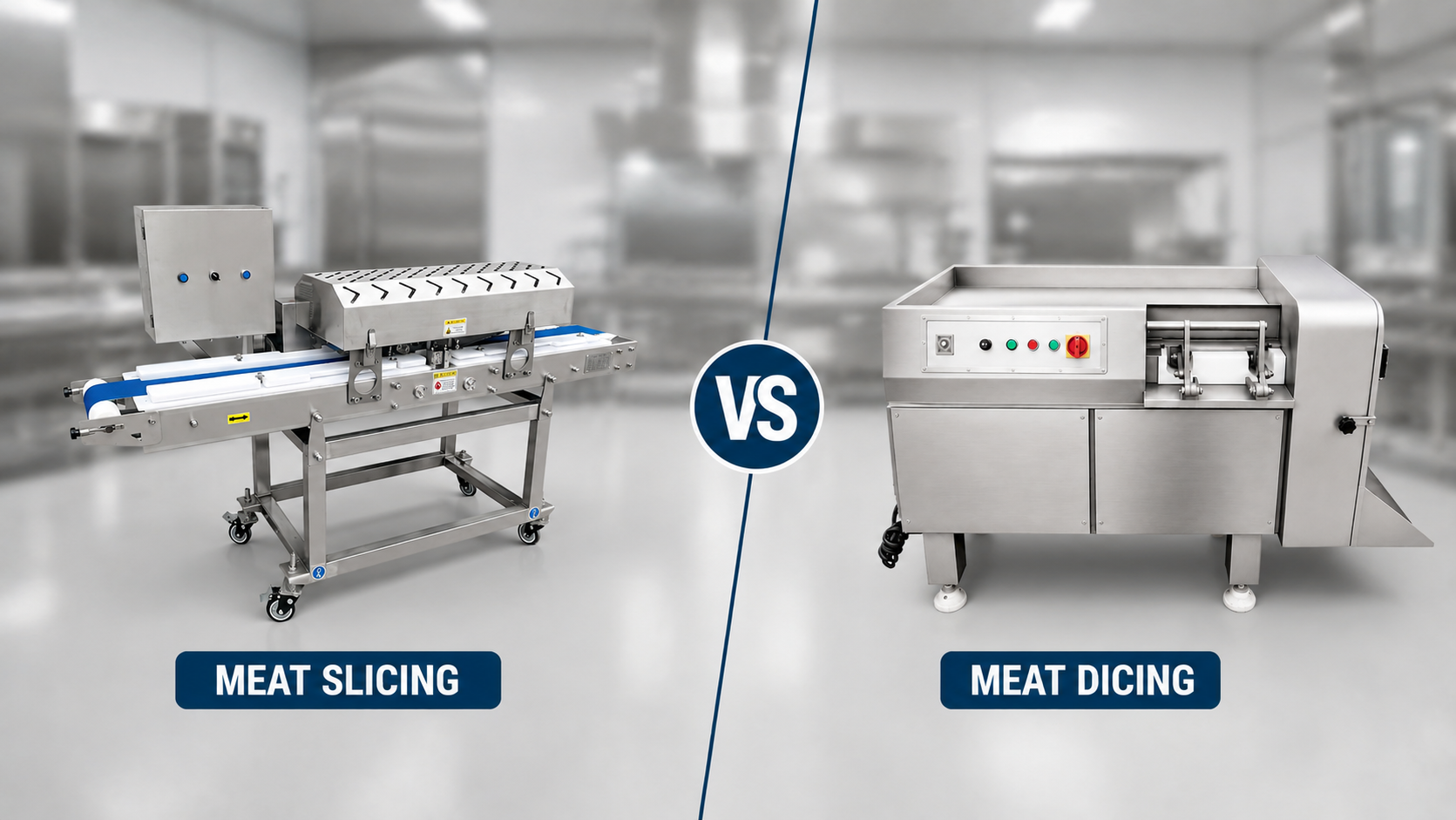
What a Slicing Machine Actually Controls
Slicing machines cut product into consistent-thickness sheets using either a rotary circular blade or a reciprocating guillotine-style blade, and the choice between them affects both cut quality and achievable speed. Beyond blade type, thickness accuracy depends on how precisely the feed mechanism advances product between cuts, and product orientation control — keeping grain direction consistent — determines whether slices come out visually uniform or with inconsistent grain pattern that shows up as a quality issue at retail packaging.
What a Dicing Machine Actually Controls
Dicing uses a multi-blade grid — typically cutting in two or three dimensions in sequence — to produce consistent cube sizes rather than sheets. Cube size consistency depends heavily on how the machine handles product density and firmness; a dicer calibrated for one texture profile can produce ragged, inconsistent cubes on product that's softer or firmer than what it was tuned for.
Why Product Temperature at the Cutter Changes the Outcome
Both slicing and dicing perform measurably better on semi-frozen product than on fully fresh, room-temperature-adjacent meat. Semi-frozen product holds its structure under the blade, cutting cleanly with minimal deformation or smearing, while fully fresh product is more prone to tearing, uneven edges, and blade drag — defects that show up as both a yield loss and a visual quality issue. This is a process parameter worth controlling deliberately rather than leaving to whatever temperature product happens to arrive at the cutting stage.
Choosing Between Slicing and Dicing — or Both
Some product specifications require both stages in sequence — stew-cut or kebab-cut product, for instance, is sometimes sliced first to a controlled thickness and then diced to final cube size, since attempting to dice directly from a whole cut without the intermediate slicing stage produces less consistent results. Matching your actual portion format requirement to the right single machine or combined sequence, rather than assuming any cutting equipment achieves any format, is the specification decision that determines whether the finished product matches the spec sheet at scale.
Talk to Meatech About Your Cutting Line
Meatech supplies meat slicing and dicing machines individually or in sequence, sized to your target portion format and product temperature profile. Contact our team to review your current cutting setup against the format consistency you're targeting.

We warmly invite potential customers, agents and distributors to partner with us — to explore markets together and share in the opportunities that a growing global food processing industry continues to present.
SOLUTIONS
CONTACT US
Building 1, Tianyi Renhe Longyue Shangjing, No. 15 Xiangtan Road, Chengyang District, Qingdao, China
Copyright © 2026 Qingdao Meatech Machinery Technology Co.,Ltd. All Rights Reserved.


